
Most moving problems do not start on moving day. They start earlier, when someone accepts a vague quote, ignores missing details, or trusts a mover just because the price sounds comfortable. Scammers understand that people want their move to be simple, so they use pressure, sweet talk, and low estimates to make you skip the checks that matter.
That is why it is compulsory to verify a moving company in Idaho before you agree to anything.
In Idaho, local movers are generally connected to state-level requirements through the Idaho Transportation Department, while interstate movers must be registered with FMCSA and should have a valid U.S. DOT number.
In simple words, you do not have to guess whether you are dealing with legitimate movers in Idaho. You can look at the company’s details and check moving company credentials before your belongings are in their hands.
So, let’s discuss how to verify a moving company in Idaho step by step, where to check their information, and what warning signs to notice.
Idaho Licensing Requirements for Moving Companies
When you hire a mover, you are trusting strangers with almost everything inside your home. That is exactly why Idaho has transportation and registration requirements for companies operating in the moving industry.
Registration Through the Idaho Transportation Department (ITD)
For movers operating within Idaho, the Idaho Transportation Department (ITD) plays an important role in commercial carrier oversight.
Unlike some heavily regulated states, Idaho does not currently require a traditional household goods certificate like a CPCN for intrastate movers.
This typically includes:
- Commercial carrier registration through the Idaho Transportation Department.
- Compliance with state transportation and safety requirements.
- A valid USDOT number for many commercial vehicles operating in Idaho.
- Proper business registration and operational authority, where applicable.
USDOT Number Requirements
Many people assume USDOT numbers are only required for interstate movers, but Idaho rules can apply even for intrastate operations, depending on vehicle weight.
In Idaho:
- Commercial carriers operating vehicles over 10,000 pounds generally require a USDOT number.
- Vehicles exceeding 8,000 pounds unladen weight may also trigger registration requirements.
- The USDOT number allows consumers to review company safety records, inspections, complaint history, and operating status.
Insurance Requirements (Liability and Cargo Coverage)
Idaho transportation requirements commonly involve:
- Public liability insurance for bodily injury and property damage.
- Cargo protection coverage for customer belongings during transportation.
- Insurance filings that may include Form E or BMC-91X documentation, depending on operational classification.
For many commercial carriers operating larger vehicles in Idaho, minimum liability coverage requirements can reach:
- $750,000 Combined Single Limit (CSL) liability coverage for vehicles over 10,000 pounds.
- Federal cargo insurance minimums often include $5,000 per vehicle and $10,000 per occurrence for household goods carriers.
Broker Registration and Bond Requirements
Some businesses advertising moving services are not actual movers. They work as brokers, meaning they arrange transportation through another carrier.
For federally regulated brokers:
- They must register with FMCSA.
- They are required to maintain a $75,000 surety bond or trust fund agreement.
- Their broker authority can be verified through the FMCSA databases.
Federal Registration for Interstate Movers
If a moving company transports household goods across state lines, federal rules apply in addition to Idaho requirements.
Interstate movers must:
- Register with the Federal Motor Carrier Safety Administration (FMCSA).
- Obtain an active USDOT number.
- Maintain federally required insurance filings.
- Comply with federal consumer protection and transportation laws.
How to Verify a Moving Company in Idaho
If you follow the steps below carefully, you will be able to verify a moving company in Idaho using real business records, federal databases, and public registration systems.
Step 1: Confirm Your Move Type in Idaho
This is the first thing you should figure out because the type of move determines which laws and databases apply to your mover.
When Idaho State Rules Apply
If your belongings are being moved from one Idaho location to another Idaho location, you are dealing with an intrastate move.
For example:
- Boise to Idaho Falls
- Nampa to Coeur d’Alene
- Pocatello to Twin Falls
In these cases, Idaho transportation and commercial carrier requirements apply. The company should have proper business registration and operate legally within the state.
When Federal Regulations Apply
If your move crosses state lines, federal rules apply immediately.
Examples include:
- Idaho to Utah
- Idaho to Washington
- Idaho to Oregon
- Idaho to Nevada
Interstate movers must be registered with the Federal Motor Carrier Safety Administration (FMCSA) and carry an active USDOT number.
A simple way to remember it:
- Idaho-only move: check Idaho business and transportation records first.
- Cross-state move: check FMCSA registration first, then verify all company details match everywhere else.
Step 2: Check Idaho Business and Carrier Registration
Unlike some states, Idaho does not operate a traditional household goods mover certificate system like a Public Service Commission certificate. That means consumers need to verify several pieces of information together instead of relying on one license alone.
How to Search Idaho Records
Here is the process:
- Check the Idaho Secretary of State business search database.
- Search the exact company name shown on the estimate, invoice, and website.
- Search any alternate names or DBAs the company uses online.
- If the mover claims they are licensed, ask for their USDOT number and commercial registration details.
What Information Should Match
When reviewing records, consistency matters more than people realize.
Look for matching details across:
- Legal business name
- Business address
- Phone number
- Website information
- USDOT registration details
- Insurance filings where applicable
Step 3: Verify Federal Registration for Interstate Movers
Many fraudulent movers count on customers never checking federal records.
FMCSA Registration Check
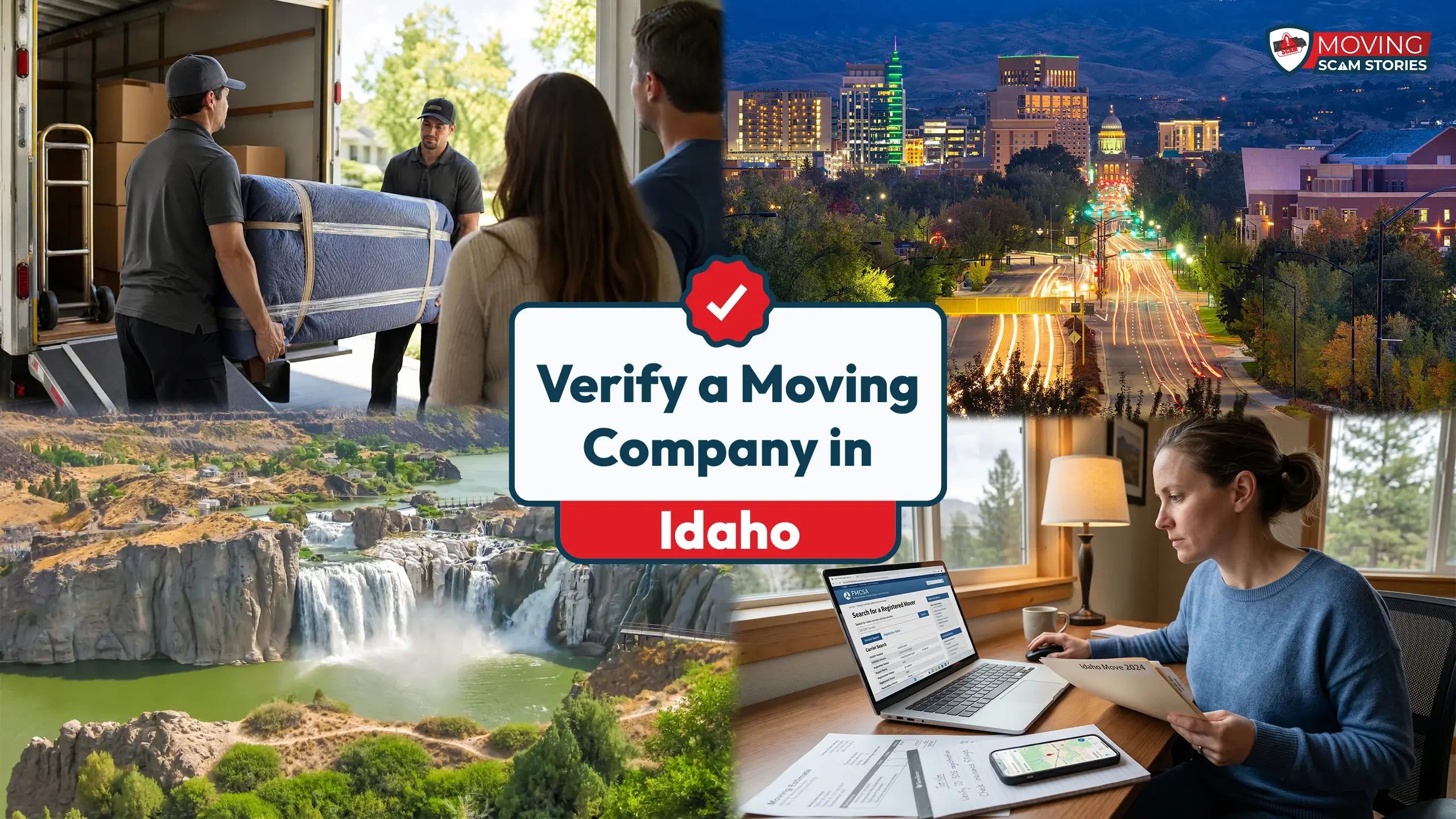
Use the FMCSA “Search for a Registered Mover” tool.
You can review:
- Registration status
- Company location and contact details
- Whether the company is listed as a carrier or broker
- Safety and complaint information
- Operating authority status
This is one of the most important steps if you want to verify a moving company in USA using official federal databases.
USDOT Number Verification
Interstate movers should always provide a USDOT number upon request.
You can verify it through:
- FMCSA mover search tools
- SAFER Company Snapshot database
What you want to see:
- USDOT status marked “Active”
- Operating authority marked “Authorized”
- Company details matching the estimate and website.
As of current FMCSA standards, commercial interstate carriers generally require:
- A valid USDOT number.
- Minimum $750,000 liability insurance for many commercial carriers over 10,000 pounds.
- Federal cargo coverage filings for household goods transport.
Step 4: Confirm Business Registration in Idaho
A company can technically exist as a business entity while still operating improperly as a mover.
That is why business registration alone is never enough.
Business Name Registration in Idaho
Use the Idaho Secretary of State Business Search system.
What to do:
- Search the business name exactly as written on the estimate.
- Open the entity profile.
- Check the company status and registration details.
- Review the registered address and filing history.
Confirm Legal Name vs DBA Records
This is where many scams become visible.
Some movers advertise under one name but use another legal entity on contracts and invoices.
So ask directly:
- “What exact legal business name will appear on my contract?”
- “Does that name match your FMCSA and business registration records?”
Then compare:
- Business entity records
- USDOT records
- Website details
- Estimate paperwork
Step 5: Verify Physical Presence and Local Operations
You want proof that the company genuinely operates where it claims.
Look for:
- A real commercial address instead of only a mailbox or apartment
- Branded trucks with matching company names
- A working business phone number
- Employees who clearly identify the company
- Local reviews connected to a real operating location
Step 6: Check Insurance and Liability Coverage
Professional movers should always carry insurance and provide proof when requested.
Ask for:
- General liability insurance
- Cargo insurance coverage
- Worker protection coverage, where applicable
- Broker bond information if they operate as brokers
Step 7: Review Consumer Complaints and Enforcement Records
This step tells you how the company behaves after getting paid.
Idaho Consumer Complaint Checks
You can review complaints and consumer protection resources through:
- Idaho Attorney General Consumer Protection Division
- FMCSA complaint databases
- Better Business Bureau records
- Google review patterns across multiple locations
Pay close attention to repeated complaints involving:
- Held belongings
- Last-minute price increases
- Delivery delays
- Damaged items
- Unanswered customer calls
Federal Complaint Records
For interstate movers, FMCSA also provides access to complaint systems through the National Consumer Complaint Database (NCCDB).
Consumers can:
- File complaints online
- Call 1-888-DOT-SAFT (1-888-368-7238)
- Report unauthorized operations or fraud
If you have personally dealt with fraud or deceptive practices, you can also submit your scam story.
Step 8: Verify Estimates and Moving Documents
Before signing anything:
- Get a written estimate
- Review every fee carefully
- Confirm pickup and delivery details
- Check whether packing, stairs, storage, or mileage charges are included
- Verify the company name matches all records you checked earlier
Step 9: Confirm Final Operational Details Before Hiring
This is your final verification step before paying a deposit or signing a contract.
Ask direct questions:
- Who will physically handle the move?
- Will subcontractors be involved?
- What happens if items are damaged?
- What payment methods are accepted?
- When is payment due?
- What is the expected delivery timeline?
Who Will Handle the Move (Carrier vs Broker)
FMCSA separates movers into carriers and brokers.
A carrier:
- Uses its own trucks and crews
- Physically transports your belongings
A broker:
- Arranges the move
- Hires another carrier to perform the transport
So ask:
- “Are you the carrier or a broker?”
- “If you are a broker, who is the actual carrier?”
- “What is the carrier’s USDOT number?”
- “Can I verify that company separately?”
Consumer Rights When Hiring Movers in Idaho
Most people do not think about consumer rights until something goes wrong during the move. By that point, the truck is loaded, the deposit is paid, and stress levels are already high.
That is why understanding your rights before hiring a mover matters so much.
Right to Hire Properly Registered and Insured Movers
In Idaho, commercial movers operating legally are expected to comply with state transportation laws and, when applicable, federal FMCSA regulations.
You have the right to:
- Work with properly registered and licensed moving companies
- Request proof of USDOT registration if applicable
- Ask for proof of insurance coverage
- Confirm business registration records through the Idaho Secretary of State
- Refuse service if the company cannot provide valid operational details
Right to Written Estimates
For interstate moves, FMCSA consumer protection regulations require movers to provide written estimates and federally required disclosures.
For Idaho moves, you still have the right to:
- Request a detailed written estimate
- Review all listed charges before signing
- Ask whether the estimate is binding or non-binding.
- Understand fees related to labor, stairs, fuel, storage, mileage, or packing supplies
Right to Clear Contracts and Documentation
Before your move begins, you should receive complete documentation explaining the service agreement.
This includes:
- A bill of lading or moving contract
- Terms and conditions
- Insurance or valuation coverage information
- Company contact details
- Pickup and delivery timelines
You have the right to:
- Read everything before signing
- Ask questions about unclear terms
- Request corrections before loading begins
- Keep copies of all signed paperwork
Right to Insurance and Liability Protection
Legitimate movers should carry insurance protection for both public liability and customer belongings.
You have the right to:
- Ask what type of protection applies to your belongings
- Understand valuation coverage options
- Request written confirmation of liability limits
- Review proof of insurance before moving day
Right to Fair Pricing and No Surprise Charges
You have the right to honest pricing before your belongings are loaded onto a truck.
That includes:
- Clear pricing disclosures
- Written explanations of additional fees
- Advance notice of extra charges
- Accurate estimates based on inventory and distance
If a mover suddenly doubles the price on moving day without explanation, that is a serious red flag.
Right to Know Whether You Are Hiring a Carrier or a Broker
This is one of the most overlooked parts of hiring movers.
You have the right to know:
- Whether the company is the actual moving carrier
- Or whether they are a broker arranging transportation through another company
If they operate as brokers:
- They should disclose that clearly
- They should identify the actual carrier handling your belongings
- You should be able to verify that the carrier independently through FMCSA records
Right to Refuse Service Before Loading Begins
You are not forced to continue simply because the truck arrived.
You have the right to stop the move if:
- The company name does not match your paperwork
- The movers cannot provide identification
- The contract suddenly changes
- The price increases without explanation
- The mover refuses to answer basic questions
Right to Protect Yourself From Fraud and Scams
You always have the right to protect yourself before signing a contract or paying a deposit.
That includes the right to:
- Take time before making a decision
- Research company records carefully
- Compare multiple movers
- Review complaints and safety history
- Ask for documentation
- Say no without pressure
Where to Report a Fraudulent Moving Company in Idaho
Even when people do everything carefully, problems can still happen during a move. If that happens, you are not helpless. Idaho consumers have both state and federal reporting options available when dealing with dishonest movers or suspected fraud.
Idaho Attorney General Consumer Protection Division
For many Idaho moving complaints, the Idaho Attorney General Consumer Protection Division is one of the most important places to report deceptive business practices.
This office handles complaints involving:
- False advertising
- Misleading pricing practices
- Fake business claims
- Unauthorized operations
- Deposit-related fraud
- Deceptive claims
You should consider reporting here if the mover:
- Refused to honor the written estimate
- Misrepresented insurance or licensing status
- Used misleading contracts
- Operated under suspicious business names
- Engaged in deceptive conduct
How to File a Complaint in Idaho
Before submitting a complaint, gather as much documentation as possible.
Helpful records include:
- Company name and contact information
- Written estimates and contracts
- Payment receipts
- Text messages or emails
- Photos of damages
- Timeline of events
- USDOT number, if available
Idaho Transportation and Registration Concerns
If the issue involves commercial carrier violations, false transportation authority claims, or improper operations, you also report concerns connected to transportation compliance and registration violations.
This may include situations where companies:
- Operate commercial moving vehicles improperly
- Display invalid USDOT numbers
- Use misleading carrier information
- Fail to maintain proper operational records
Federal Reporting Options
Interstate movers and brokers fall under the authority of the Federal Motor Carrier Safety Administration (FMCSA).
You should report the company federally if:
- The move involved another state.
- The company used a fake USDOT number.
- Your belongings were held hostage.
- The mover demanded additional payment before delivery.
- You discovered false claims related to moving company license status or federal authority.
- The company violated FMCSA consumer protection rules.
Federal Complaint Channels
1. FMCSA National Consumer Complaint Database (NCCDB)
This is the main federal complaint system for interstate moving issues.
Consumers can:
- File complaints online
- Call 1-888-DOT-SAFT (1-888-368-7238)
- Report unauthorized operations or fraud involving interstate movers
You should provide:
- USDOT number
- Company name and address
- Contract documents
- Estimate copies
- Detailed explanation of the issue
2. Federal Trade Commission (FTC)
The Federal Trade Commission also accepts complaints involving:
- Deceptive advertising
- Business fraud
- Deposit theft
- Online scam operations
- Fake review manipulation
- Consumer fraud connected to moving services
FTC reports help authorities identify broader scam patterns operating across multiple states.