
Quick answer: Yes, packing yourself when moving can help reduce certain types of moving scams, but it does not eliminate scam risks completely. When you handle your own packing, you limit a mover’s ability to overcharge for packing services, claim damage caused during packing, or inflate costs using packing-related excuses. Self-packing gives you more control—but not total protection.
Overview
Every year, tens of thousands of people report a moving scam to consumer protection agencies, and many more never report it at all.
The most common pattern is the same. A mover gives a low estimate, loads the truck, and then suddenly the price goes up, the delivery is delayed, or personal items go missing.
When people start searching for answers, one question keeps coming up again and again: Does packing yourself when moving actually reduce the chances of getting scammed?
If you are asking this, you are probably trying to protect your belongings and avoid surprise charges. Many people believe that if they pack themselves, movers will have fewer excuses to overcharge or blame damage on packing issues.
It looks logical, and in some cases, it works. But the reality is a little more nuanced than a simple yes or no.
Let’s discuss how packing yourself when moving changes the power balance between you and the mover. If you have heard moving scam stories or worried about becoming one yourself, this will help you understand what truly protects you during a move and what does not.
What “Packing Yourself” Changes in a Move
When you hear someone say, “I’ll just pack everything myself,” it sounds simple. But in reality, packing yourself when moving changes how much control you have over the move, how disputes happen, and even how scams play out.
What movers normally handle when they pack
When you let movers do the packing, you are handing over more than just boxes. You are handing over responsibility, timing, and documentation.
Movers usually decide:
- What packing materials are used, and how much of them are needed
- How items are wrapped, boxed, and labeled
- How long packing takes and how much labor is billed
- How damage is classified later if something breaks
This is where many moving scam complaints begin. A mover might say, “This item was fragile, so it needed extra materials,” or “Packing took longer than expected,” and suddenly your bill increases.
If something arrives damaged, the blame game starts. You may hear, “It was packed properly when we handled it,” which makes it harder for you to argue.
What you control when you self-pack
When you pack on your own, the dynamic shifts. You are no longer guessing what happened inside a sealed box. You already know. DIY packing gives you practical leverage, not just peace of mind.
When you self-pack, you control:
- What goes into each box and how it is protected
- How boxes are labeled and inventoried
- Which items are fragile, high-value, or essential
- The condition of your belongings before pickup
This level of control directly protects belongings during a move. It also limits certain excuses movers use later.
If a mover claims, “We had to repack items,” or “Packing issues caused delays,” you can confidently say, “Everything was already packed and ready.”
Many people ask, " Is it safer to pack yourself when moving? From a scam-prevention perspective, it often is because fewer services mean fewer opportunities for manipulation.
That does not mean it removes all risk, but it does reduce some of the most common pressure points.
Scams Self-Packing Can Reduce
Packing yourself does not turn a bad mover into a good one. But it does remove several common opportunities where dishonest movers take advantage of customers.
Here are the main scam areas where self-packing actually helps:
Packing-related upcharges that appear after loading
One of the most common moving scams starts with a low quote and ends with unexpected fees. When movers pack for you, they control the narrative around time, materials, and labor.
You may hear things like:
- “We had to use more boxes than expected.”
- “Your items needed extra protection.”
- “Packing took longer than estimated.”
When you pack yourself when moving, these excuses disappear. There is no packing labor to extend, no extra materials to justify, and no last-minute packing charges to add. The scope of work is clearer, and that alone removes a major pricing loophole.
Damage claims being used against you
Another common issue involves damage claims. When movers pack your belongings, they may later claim that damage existed before the move or that items were packed correctly and still broke. This puts you in a weak position because you did not see how the items were packed.
With DIY packing, you know exactly how items were wrapped and boxed. You can document the condition before pickup. If something gets damaged, you are no longer guessing what happened. You can clearly show how the item was packed and what condition it was in before the move.
Inventory confusion and “missing item” disputes
Missing items are a frequent trigger for moving scam complaints. When movers pack, they create the inventory themselves. Boxes may be labeled vaguely or grouped without detail, which creates room for confusion later.
When you self-pack:
- You label boxes clearly
- You know what is inside each one
- You can maintain your own inventory list
This reduces disputes like, “That box was never on the truck,” or “That item was not listed.” While it does not guarantee recovery, it reduces ambiguity, which is exploited in scam situations.
Pressure tactics tied to packing delays
Some dishonest movers use packing delays as leverage. They arrive late, pack slowly, and then rush you with statements like, “We’re already behind, so costs will increase,” or “We need to load now or reschedule.”
When everything is already packed, that pressure disappears. The truck loads or it does not. There is no gray area to exploit.
Fewer excuses, fewer arguments
At the heart of many moving scam stories is confusion. Confusion about who packed what, when it happened, and who is responsible. Self-packing simplifies the story. Fewer services mean fewer variables, and fewer variables mean fewer excuses.
That is why many people who have dealt with a moving scam later say, “I wish I had packed everything myself.”
Scams Self-Packing Does Not Prevent
This part matters just as much as the previous one. A lot of people assume that once they finish packing, the risk is gone. That assumption is where many moving scam stories begin.
Packing yourself when moving removes some problems, but it does not protect you from every dishonest tactic in the industry.
Hostage load and delivery delay scams
This is one of the most serious and stressful types of moving scam. Your belongings are loaded onto the truck, and then the mover demands more money before delivery. Sometimes they claim unexpected costs. Other times, they simply delay delivery until you pay.
Self-packing does not stop this because the scam has nothing to do with packing. It is about control of the truck and your belongings.
Weight or volume inflation
Another scam that self-packing cannot prevent is inflated weight or volume. Movers may claim your shipment weighs more than estimated or takes up more space than expected, then charge you accordingly.
Since the mover controls the truck or the volume calculation, packing your own boxes does not change this.
You might hear something like, “Once everything was loaded, we realized it was much heavier.” Packing has no influence here.
Bait-and-switch pricing tactics
Some movers deliberately offer unrealistically low estimates to secure the booking. After loading, the price suddenly increases. This tactic shows up in many moving scam stories, and it often surprises people who thought self-packing would protect them.
Even if you pack yourself, a dishonest mover can still change pricing based on fabricated reasons unrelated to packing.
Broker-related scams
Self-packing also does nothing to protect you from shady brokers. Brokers do not move your belongings. They sell your job to another company, sometimes without your knowledge.
When something goes wrong, no one takes responsibility. This is a common source of unresolved moving scam complaints.
False sense of security
Perhaps the most dangerous risk is psychological. When people focus only on packing, they may ignore warning signs elsewhere. They might skip researching the mover, overlook contract terms, or fail to verify licensing.
Self-packing helps with specific problems, but it is not a shield against unethical business practices.
One key takeaway: Packing yourself when moving is a tool, not a guarantee. It works best when combined with careful mover selection, clear documentation, and an understanding of how moving scams actually happen.
When Self-Packing Can Increase Risk
Up to this point, packing yourself may sound like the safer option. And in many cases, it is. But there is an important side of the conversation that often gets ignored. Self-packing can also increase risk if it is done without understanding how movers, insurance, and liability actually work.
This is where many people unintentionally create problems for themselves.
When damage becomes “your responsibility”
One of the most common surprises happens after delivery. An item arrives damaged, and the mover says, “This was owner-packed.”
If you self-pack poorly, movers can legitimately deny responsibility. For example:
- Fragile items packed without proper cushioning
- Heavy items placed in weak boxes
- Glass or electronics packed without internal protection
In these situations, the damage may not be a scam at all. It may be a direct result of packing mistakes.
Insurance and claim limitations
Many people assume insurance works the same no matter who packs. That is not true. When movers pack, they accept more liability for how items are protected. When you self-pack, coverage can be limited or denied if damage is blamed on packing quality.
This creates risk in two ways. First, you may lose compensation for real damage. Second, dishonest movers may use this limitation as an excuse, even when the damage happened during transport.
Unsafe or unprofessional packing leading to refusal
Another overlooked risk is movers refusing to transport certain items. If boxes are overloaded, poorly sealed, or leaking, movers may delay the move or demand repacking fees.
For example, a mover might say, “These boxes are unsafe to load,” and then charge for repacking or refuse responsibility for those items. In extreme cases, this can lead to unexpected costs.
Increased stress and rushed decisions
Self-packing requires time, energy, and planning. When people underestimate the effort, they rush at the last minute. Rushed packing leads to weak boxes, poor labeling, and forgotten documentation.
Ironically, this chaos can create the same confusion that scammers exploit. Lost items, unclear inventories, and unsealed boxes all increase vulnerability during disputes.
How to Self-Pack in a Scam-Resistant Way
If you decide to go ahead with DIY packing, then the goal is to pack in a way that leaves very little room for confusion, denial, or manipulation later.
Start with a simple inventory system
Before you tape the first box, decide how you will track your belongings. This does not need to be complicated.
Here is what works well:
- Number each box clearly
- Write a short description of the contents
- Keep a master list on your phone or notebook
For example, “Box 12 – kitchen glassware and plates.” This prevents disputes about what was loaded and what was delivered.
Photograph and record before loading
Documentation is one of the strongest tools you have against a moving scam. Before movers arrive, take clear photos or short videos of:
- High-value items
- Fragile items before boxing
- Sealed and labeled boxes
If damage or loss occurs, you can show what condition the items were in and how they were packed.
Many people who share moving scam stories later say they wish they had documented more.
Use the right materials
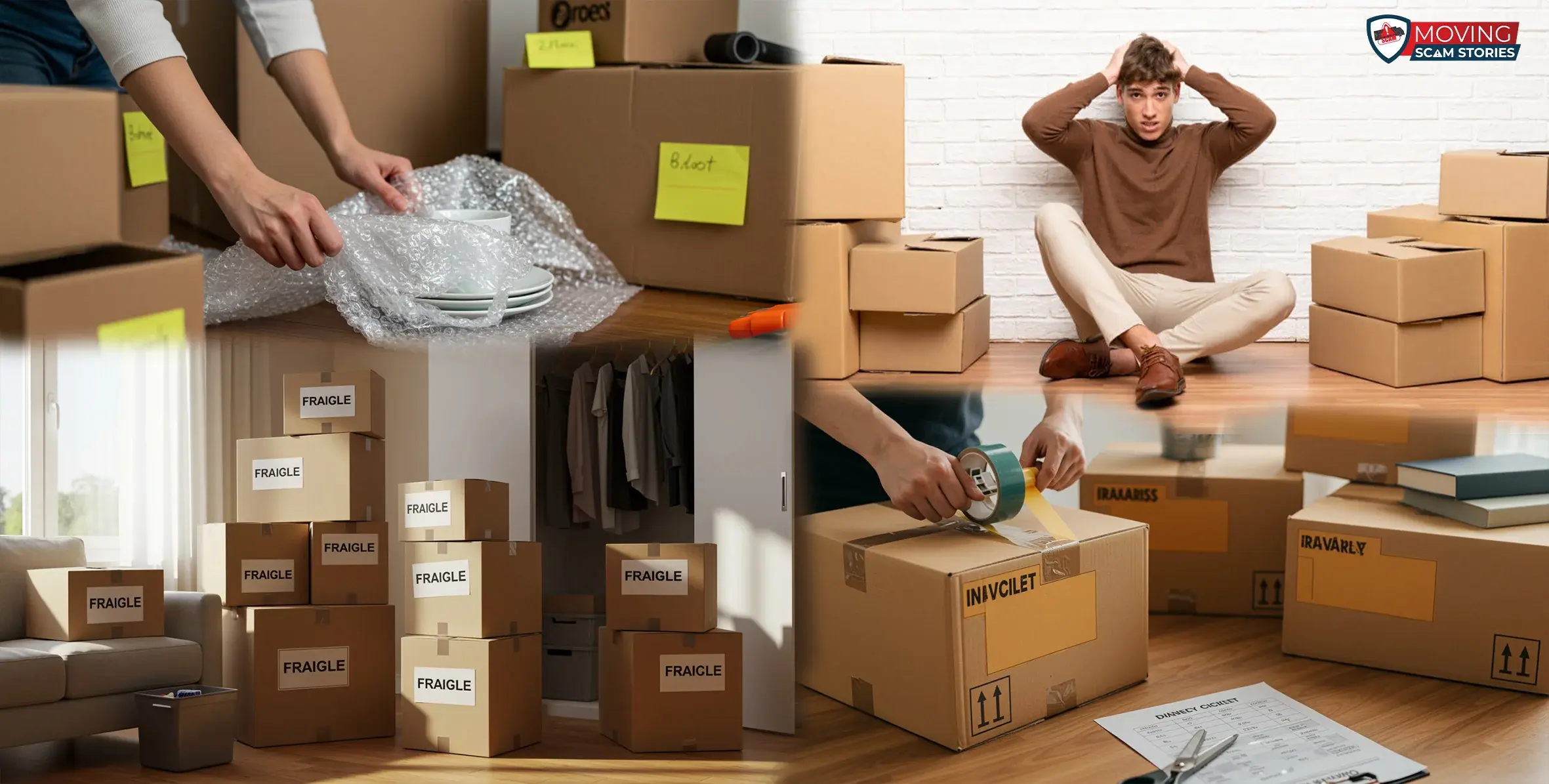
Boxes that look fine sitting in a room can fail during transport. Use sturdy boxes, proper cushioning, and strong tape. Avoid mixing heavy and fragile items in the same box. Fill the empty space so items cannot move inside.
These are basic but ignored packing tips for a safe move, and they make a real difference during disputes.
Seal and label with intention
Once a box is packed, seal it fully. Avoid half-taped flaps or loose lids. Clearly label boxes as fragile where necessary, but do not overuse warnings. Be specific instead.
For example:
- “Glassware – upright only”
- “Electronics – do not stack”
Keep essentials and valuables separate
Certain items should never go on the moving truck, no matter how well you pack. Important documents, jewelry, medications, and personal electronics should stay with you.
It removes high-risk items from potential moving scam situations entirely.
Avoid common self-packing mistakes
Some mistakes quietly weaken your position:
- Overloading boxes
- Using old or damaged boxes
- Failing to label clearly
- Skipping documentation
Confirm expectations with the mover in advance
Let the mover know in writing that everything will be owner-packed. Confirm that no repacking will occur unless you approve it. This reduces last-minute surprises and protects you from unwanted charges.
Self-Packing Recommendations by Move Type
Not every move carries the same level of risk. How far you are moving has a big impact on whether packing yourself when moving works in your favor or creates new problems.
Below are practical recommendations based on move type.
Local moves
Local moves are usually simpler and shorter, which naturally reduces scam risk.
Recommended approach for local moves:
- Self-pack fragile, valuable, and personal items to maintain control
- Allow movers to handle large furniture if they are reputable
- Keep your own inventory, even if the mover provides one
- Take photos of items before loading, even for short moves
For local moves, DIY packing is about preventing minor disputes and surprise charges rather than major scams.
Long-distance and interstate moves
This is where self-packing becomes much more important, but also more risky if done poorly. Most serious moving scam stories come from long-distance or interstate moves.
Recommended approach for long-distance and interstate moves:
- Pack all boxes yourself to avoid packing-related upcharges
- Document everything with photos and videos before pickup
- Create a detailed inventory and keep a copy separate from the mover
- Keep essentials and valuables with you at all times
- Confirm in writing that no repacking or added services will occur
Is Self-Packing Worth It for Scam Prevention?
If Your Main Concern Is Overcharging:
Yes. Packing yourself when moving directly reduces packing-related overcharges. There is no packing labor to inflate, no extra materials to justify, and fewer add-on fees.
If Your Main Concern Is Missing or Damaged Items:
Partially. Self-packing improves control, documentation, and clarity, which helps with disputes and accountability. However, damage claims can still be denied if the packing is poor. It helps—but only when done correctly and documented well.
If Your Main Concern Is Delivery Delays or Hostage Loads:
No. Self-packing does not prevent these scams. Delays and hostage loads are tied to dishonest movers, contracts, and control of the truck—not how the boxes were packed.